
Fytora
An AI-powered platform for personalised fashion discovery, outfit inspiration, and smarter shopping.

✨ The Challenge
THE PROBLEM
Large catalogues make products hard to compare.
Recommendations rely too heavily on past behaviour.
Shoppers struggle to imagine complete outfits.
Users are unsure what matches their wardrobe.
Unexplained AI recommendations feel unreliable.
WHAT ARE THE USER NEEDS?

Users need a faster way to narrow down large product catalogues without losing the freedom to explore.

They want to know whether new products will work with clothing they already own.

They want a short, low-effort method of communicating their personal style and shopping preferences.

They expect clear explanations of why products are being recommended.

They need complete outfit inspiration to understand how individual items can be styled together.

They need control over their preferences, recommendation feedback, and stored wardrobe information.

Timeline
June 2026 — August 2026
Role
UX/UI Designer
Research synthesis → product strategy → user flows → wireframes → visual design → prototyping
Design Brief
• Online shoppers feel overwhelmed by large product catalogues and repetitive choices.
• Shoppers struggle to imagine how individual items work as complete outfits or with their existing wardrobe.
• Personalisation often feels time-consuming, unclear and disconnected from the wider shopping journey.
• Users need transparent recommendations that explain why each product matches them.
✨ Research Summary
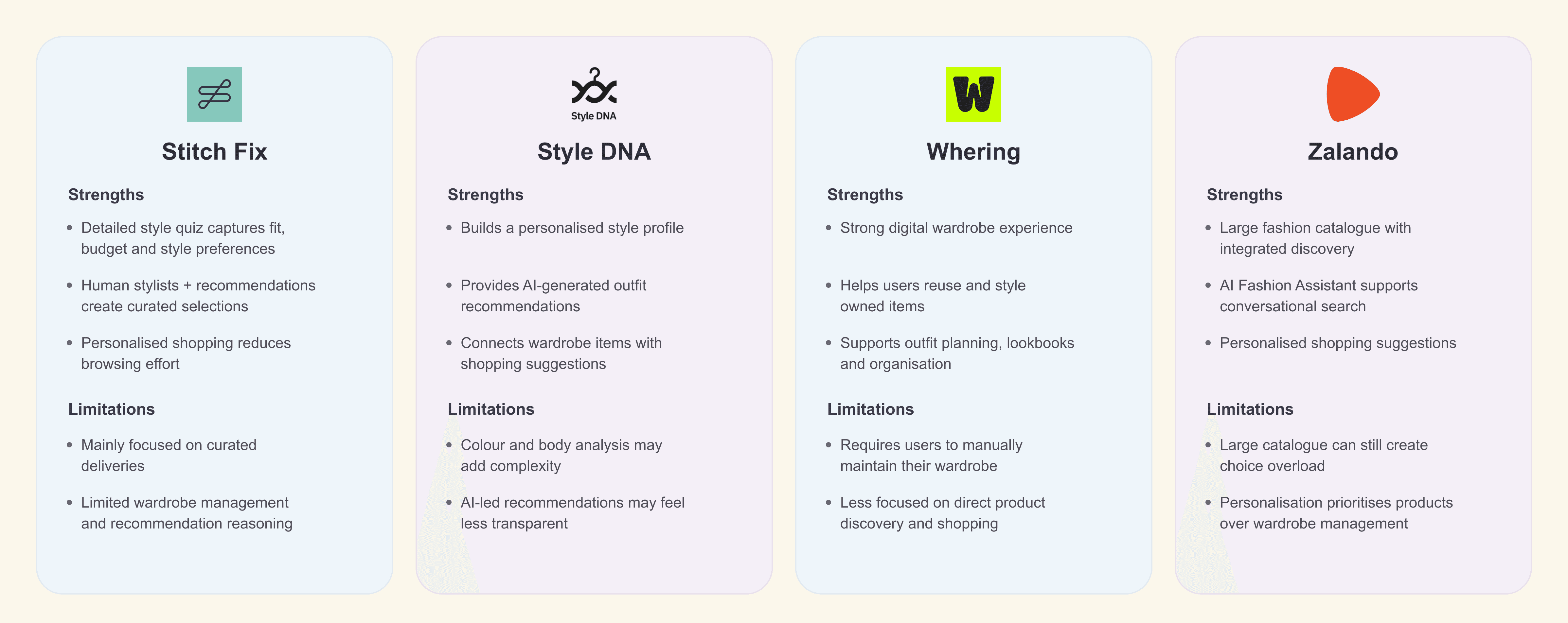
I analysed leading streaming, wellbeing and conversational AI platforms to understand how mood and emotion are currently used in content discovery.
The comparison revealed an opportunity for a low-friction, cross-media experience that responds to users’ current emotional state rather than relying mainly on past behaviour or open-ended interaction.

UNDERSTANDING THE USER
Research Inputs
• 25 survey responses
• 4 user interviews
• Secondary research into fashion e-commerce and AI-supported personalisation
Key Insights
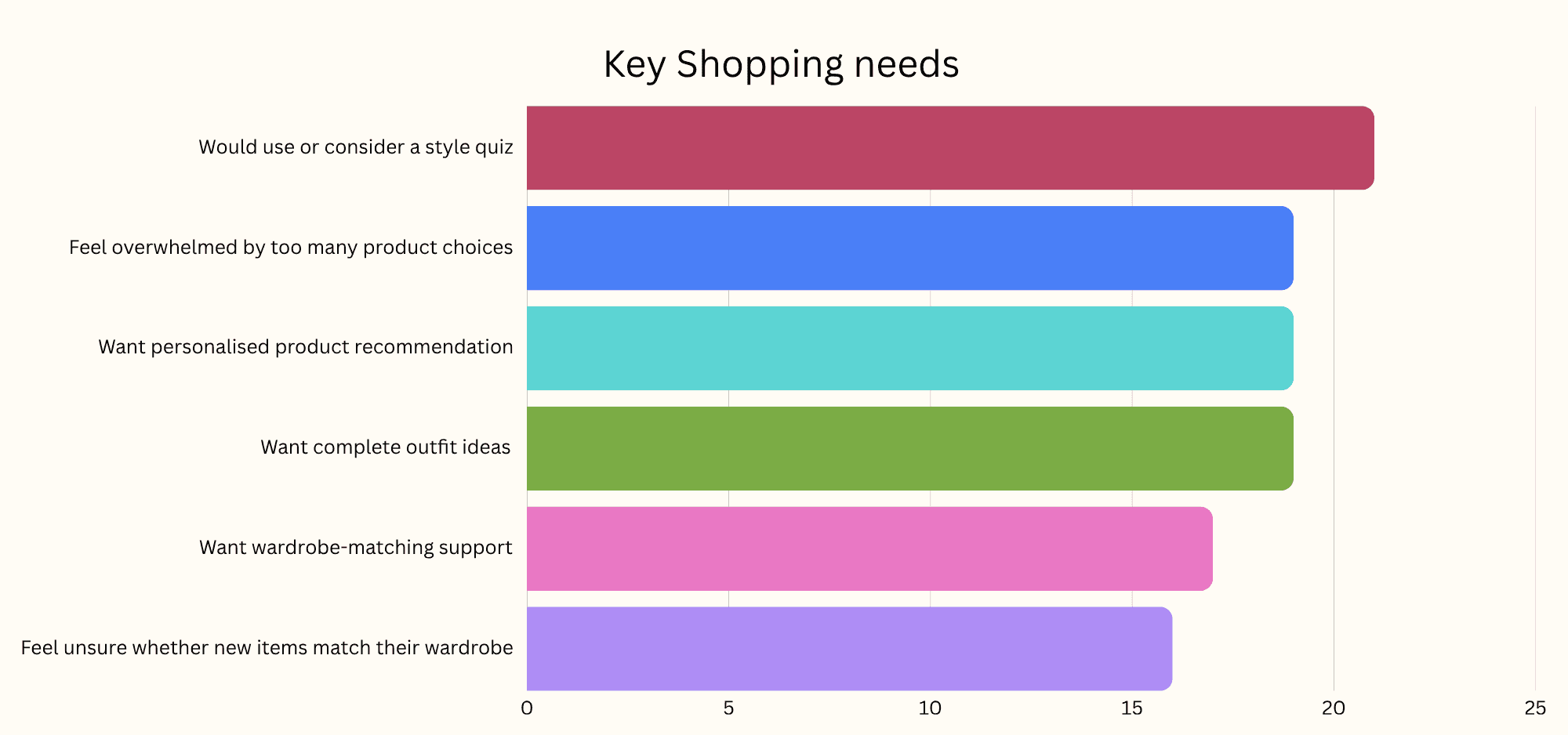
• 76% of respondents often or always felt overwhelmed by the number of fashion products available.
• 76% showed high interest in personalised products and complete outfit recommendations.
• 68% showed high interest in matching new products with their existing wardrobe.
• Users valued outfit inspiration more than simply receiving additional product suggestions.
• Privacy and inaccurate recommendations were the two strongest barriers to adoption.
• Users were more comfortable sharing general style preferences than uploading or manually building an entire digital wardrobe.
To explore how users make fashion decisions online, I combined secondary research with a synthetic exploratory survey and
affinity mapping. The research focused on choice overload, outfit confidence, personalisation, AI transparency, wardrobe
compatibility, privacy, and user control.

Market Insights & Competitor Analysis

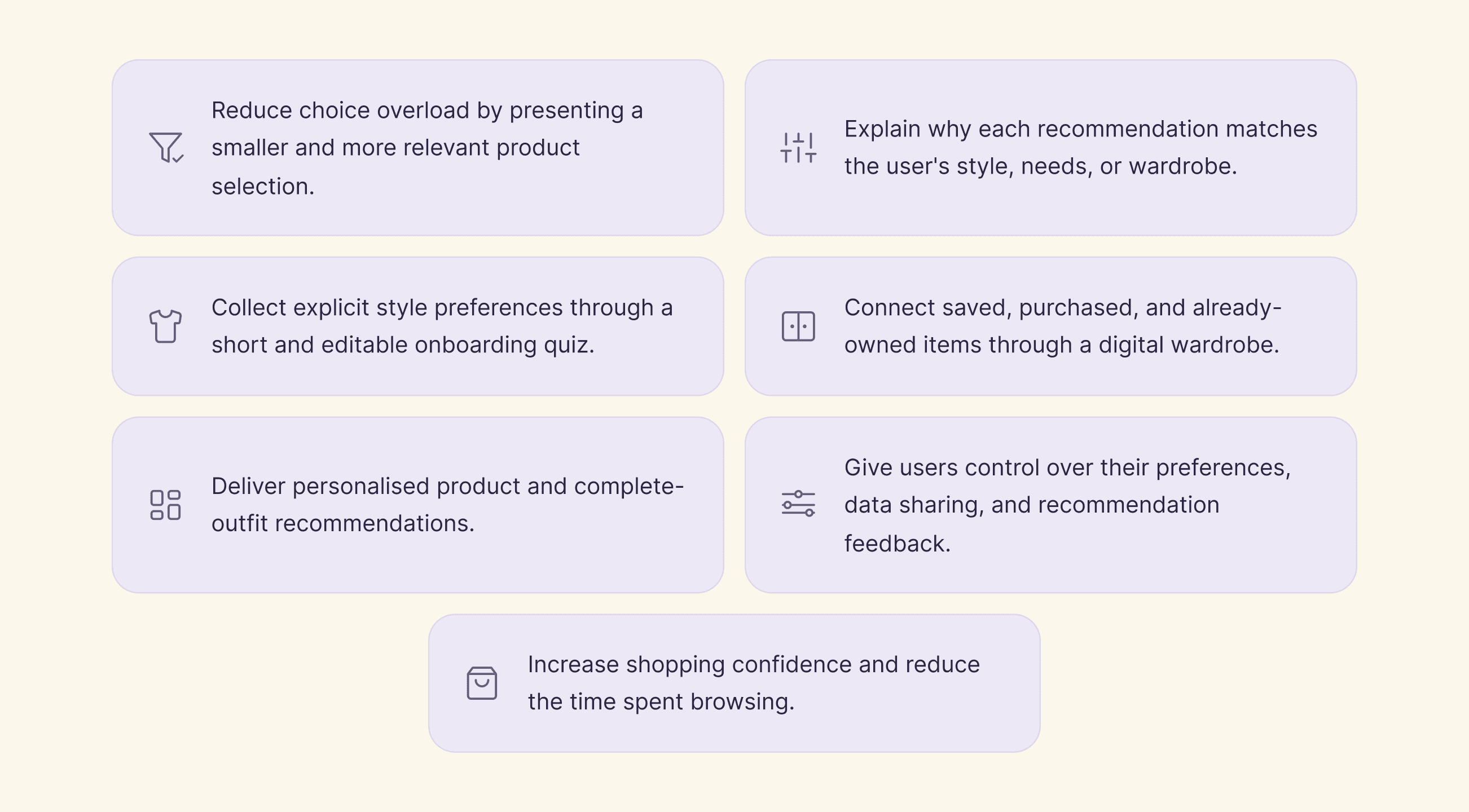
Reduce choice overload by presenting a
smaller and more relevant product selection.
Collect explicit style preferences through a
short and editable onboarding quiz.
Deliver personalised product and
complete-outfit recommendations.
Explain why each recommendation matches
the user’s style, needs, or wardrobe.
Connect saved, purchased, and already-owned
items through a digital wardrobe.
Give users control over their preferences,
data sharing, and recommendation feedback.
Increase shopping confidence and
reduce the time spent browsing.
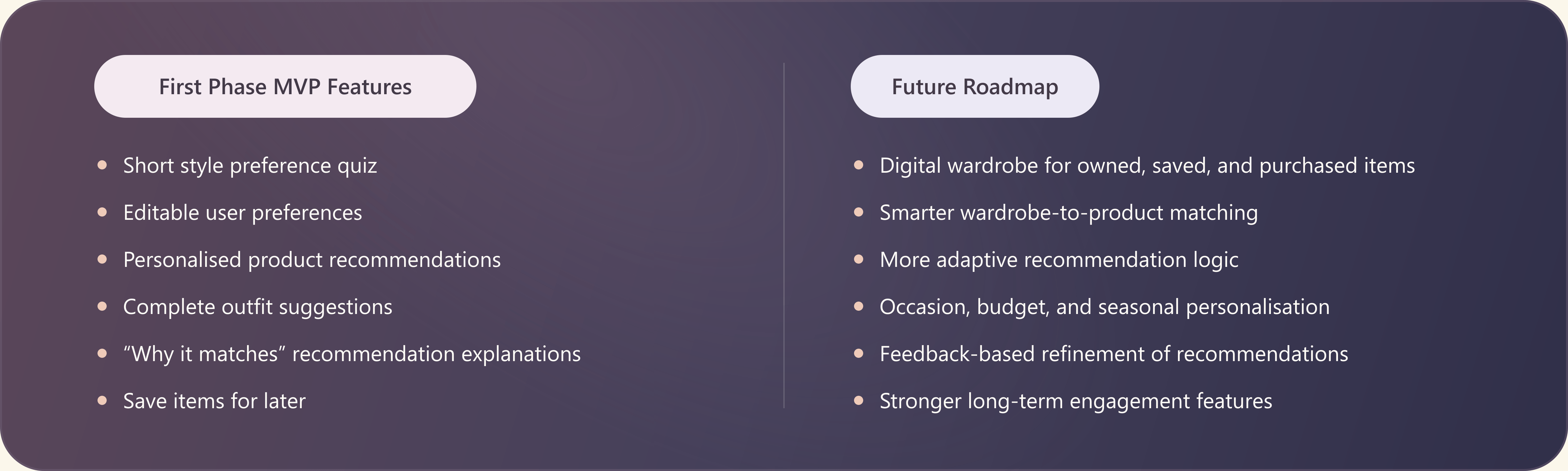
The ideation phase translated research insights into a more personalised fashion discovery experience, exploring how users could
express style preferences, receive relevant outfit recommendations, and understand why each suggestion matched their wardrobe.

PROBLEM STATEMENT & HMW QUESTIONS

Ideation
✨ Design Process
MID-FIDELITY WIREFRAMES
✨ Key Features
FEATURE (01) — Style Quiz
🌱 Capture explicit style and lifestyle preferences
🌱 Select preferred colours, fits, and occasions
🌱 Define individual wardrobe and shopping goal
🌱 Keep preferences editable over time
🌱 Build a personalised style profile from quiz responses
FEATURE (02) — Personalised Recommendations
🌱 Turn quiz responses into a personalised style profile
🌱 Curate products around style, fit, colour, and lifestyle preferences
🌱 Recommend complete outfits, not just individual items
🌱 Explain why each recommendation suits the user
🌱 Allow preferences to be edited and refined over time
FEATURE (03) — Explainable Recommendations
🌱 Show a clear match score for each recommended product
🌱 Explain why an item fits the user’s style and preferences
🌱 Highlight compatibility with pieces already in the wardrobe
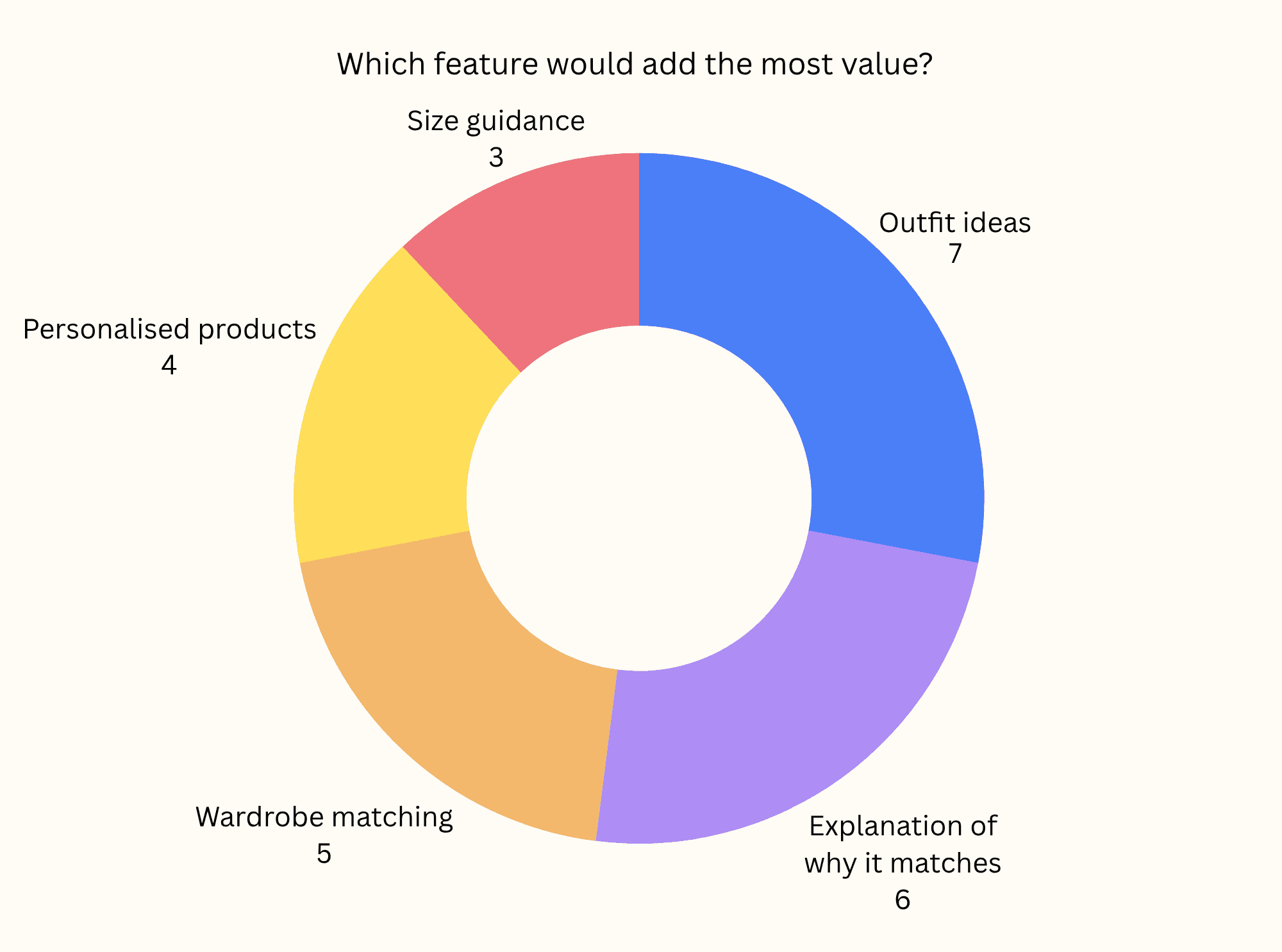
🌱 Surface useful context such as size confidence and wearability
🌱 Let users refine recommendations through simple feedback
FEATURE (04) — Outfit Ideas
🌱 Generate complete looks from existing wardrobe pieces
🌱 Tailor outfits to different occasions and everyday plans
🌱 Show how owned items can work together in new combinations
🌱 Highlight missing pieces that could complete a look
🌱 Save favourite outfits for future reference
FEATURE (05) — Digital Wardrobe
🌱 Organise saved, purchased, and owned items in one place
🌱 Build outfits using pieces already in the wardrobe
🌱 Group favourite items into capsule collections
🌱 Connect wardrobe pieces with personalised recommendations
🌱 Reuse existing clothes more effectively when planning new looks


Design System
✨ Reflections

✨ Highlights

✨ The Solution
WHAT ARE THE END GOALS OF FYTORA?
An AI-powered platform for personalised fashion discovery, outfit inspiration, and smarter shopping.
Fytora
Design Brief
• • Online shoppers feel overwhelmed by large product catalogues and repetitive choices.
• Shoppers struggle to imagine how individual items work as complete outfits or with their existing wardrobe.
• Personalisation often feels time-consuming, unclear and disconnected from the wider shopping journey.
• Users need transparent recommendations that explain why each product matches them.
Timeline
June 2026 — August 2026
Role
End-to-end UX design (research → prototype → testing)
Design Brief
• Online shoppers feel overwhelmed by large product catalogues.
• Shoppers struggle to imagine how individual items work as complete outfits.
• Personalisation often feels disconnected from the wider shopping journey.
• Users need recommendations that explain why each product matches them.
✨ Highlights
✨ The Challenge
THE PROBLEM
Large catalogues make products hard to compare.
Recommendations rely too heavily on past behaviour.
Shoppers struggle to imagine complete outfits.
Users are unsure what matches their wardrobe.
Unexplained AI recommendations feel unreliable.
WHAT ARE THE USER NEEDS?
Users need a faster way to narrow down large product catalogues without losing the freedom to explore.
They want a short, low-effort method of communicating their personal style and shopping preferences.
They need complete outfit inspiration to understand how individual items can be styled together.
They want to know whether new products will work with clothing they already own.
They expect clear explanations of why products are being recommended.
They need control over their preferences, recommendation feedback, and stored wardrobe information.
WHAT ARE THE END GOALS OF FYTORA?
✨ The Solution
✨ Research Summary
Market Insights & Competitor Analysis
I analysed leading streaming, wellbeing and conversational AI platforms to understand how mood and emotion are currently used in content discovery.
The comparison revealed an opportunity for a low-friction, cross-media experience that responds to users’ current emotional state rather than relying mainly on past behaviour or open-ended interaction.
UNDERSTANDING THE USER
To explore how users make fashion decisions online, I combined secondary research with a synthetic exploratory survey and
affinity mapping. The research focused on choice overload, outfit confidence, personalisation, AI transparency, wardrobe
compatibility, privacy, and user control.
Conducted
• 25 survey responses
• 4 user interviews
• Secondary research into fashion e-commerce and AI-supported personalisation
Key Insights
• Users often consume media as a tool for emotional regulation
• Decision fatigue occurs when browsing large content libraries
• Behaviour-based recommendations do not always reflect current emotional states
• Some users experience algorithm anxiety and avoid interacting freely
• Users prefer lightweight, intuitive interaction when expressing mood
The ideation phase translated research insights into a more personalised fashion discovery experience, exploring how users could
express style preferences, receive relevant outfit recommendations, and understand why each suggestion matched their wardrobe.
✨ Design Process
Ideation
PROBLEM STATEMENT & HMW QUESTIONS
MID-FIDELITY WIREFRAMES
✨ Key Features
FEATURE (01) — Style Quiz
🌱 Capture explicit style and lifestyle preferences
🌱 Select preferred colours, fits, and occasions
🌱 Define individual wardrobe and shopping goal
🌱 Keep preferences editable over time
🌱 Build a personalised style profile from quiz responses
FEATURE (02) — Personalised Recommendations
🌱 Turn quiz responses into a personalised style profile
🌱 Curate products around style, fit, colour, and lifestyle preferences
🌱 Recommend complete outfits, not just individual items
🌱 Explain why each recommendation suits the user
🌱 Allow preferences to be edited and refined over time
FEATURE (03) — Explainable Recommendations
🌱 Show a clear match score for each recommended product
🌱 Explain why an item fits the user’s style and preferences
🌱 Highlight compatibility with pieces already in the wardrobe
🌱 Surface useful context such as size confidence and wearability
🌱 Let users refine recommendations through simple feedback
FEATURE (04) — Outfit Ideas
🌱 Generate complete looks from existing wardrobe pieces
🌱 Tailor outfits to different occasions and everyday plans
🌱 Show how owned items can work together in new combinations
🌱 Highlight missing pieces that could complete a look
🌱 Save favourite outfits for future reference
FEATURE (05) — Digital Wardrobe
🌱 Organise saved, purchased, and owned items in one place
🌱 Build outfits using pieces already in the wardrobe
🌱 Group favourite items into capsule collections
🌱 Connect wardrobe pieces with personalised recommendations
🌱 Reuse existing clothes more effectively when planning new looks
Design System
✨ Reflections