
Vibematch
Design Brief
• Users are overwhelmed by too many content choices
• Existing systems rely on past behaviour, not real-time emotions
• Users struggle to find content that matches their current mood
Timeline
May 2025 – January 2026
Role
End-to-end UX design (research → prototype → testing)


✨ The Challenge
They want recommendations that feel personally relevant rather than repetitive or history-driven

They expect transparency and control over how their emotional input is used

They need a low-effort method to express their current mood without complex interaction

They value emotional alignment between their mood and the content suggested

Users want a simple and emotionally intelligent way to discover content that aligns with how they feel in the moment.
They seek relief from decision fatigue caused by excessive browsing


WHAT ARE THE USER NEEDS?

THE PROBLEM
Systems rely on past behaviour, not real-time emotions
Users spend too long browsing due to mood mismatch
Mood is not used as an explicit input


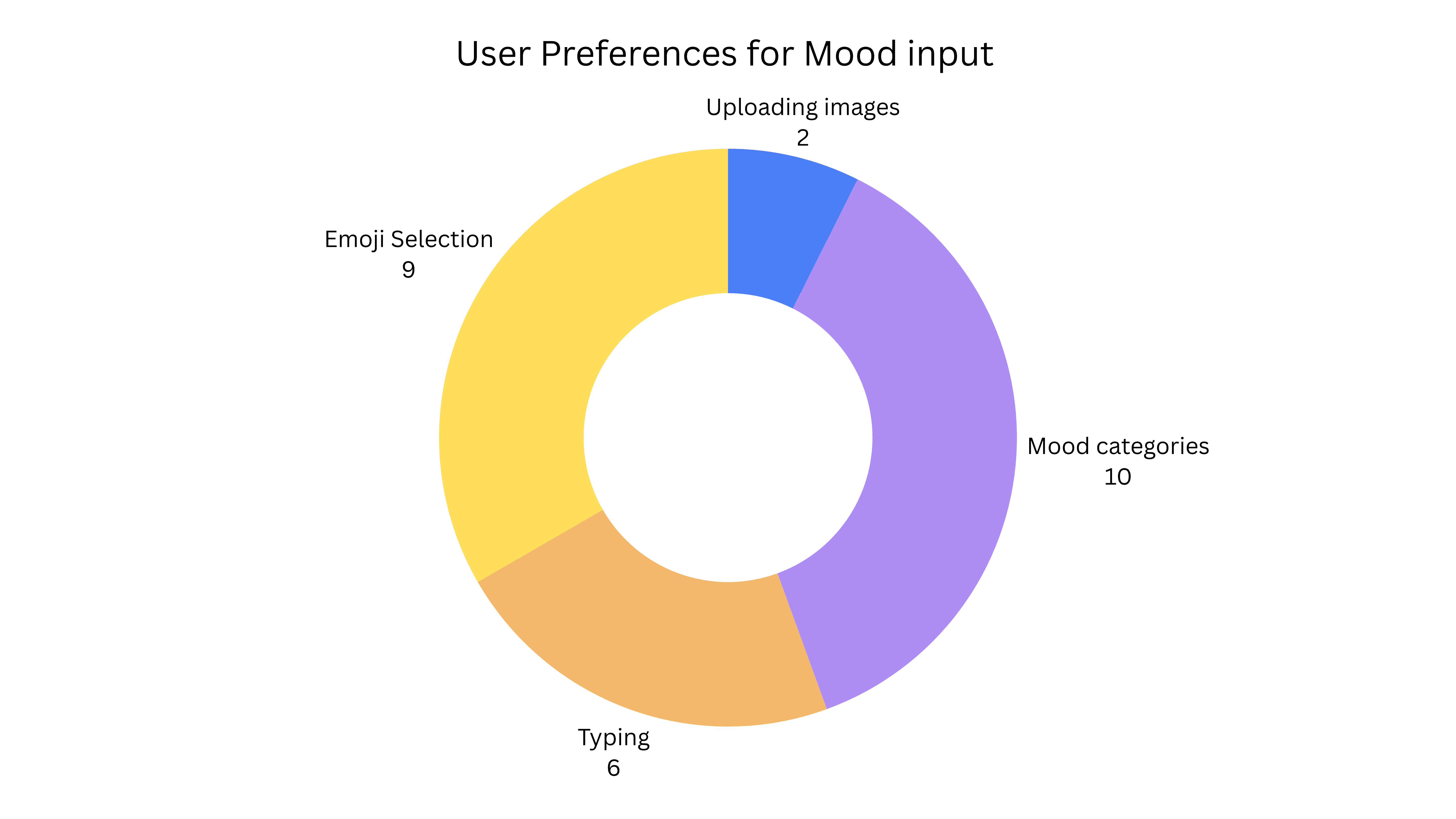
✨ Research Summary

Market Insights & Competitor Analysis
I analysed leading streaming, wellbeing and conversational AI platforms to understand how mood and emotion are currently used in content discovery.
The comparison revealed an opportunity for a low-friction, cross-media experience that responds to users’ current emotional state rather than relying mainly on past behaviour or open-ended interaction.
UNDERSTANDING THE USER
To understand how users discover entertainment content, I conducted both secondary research and primary user research.
Conducted
• 8 user interviews
• 27 survey responses
Key Insights
• Users often consume media as a tool for emotional regulation
• Decision fatigue occurs when browsing large content libraries
• Behaviour-based recommendations do not always reflect current emotional states
• Some users experience algorithm anxiety and avoid interacting freely
• Users prefer lightweight, intuitive interaction when expressing mood

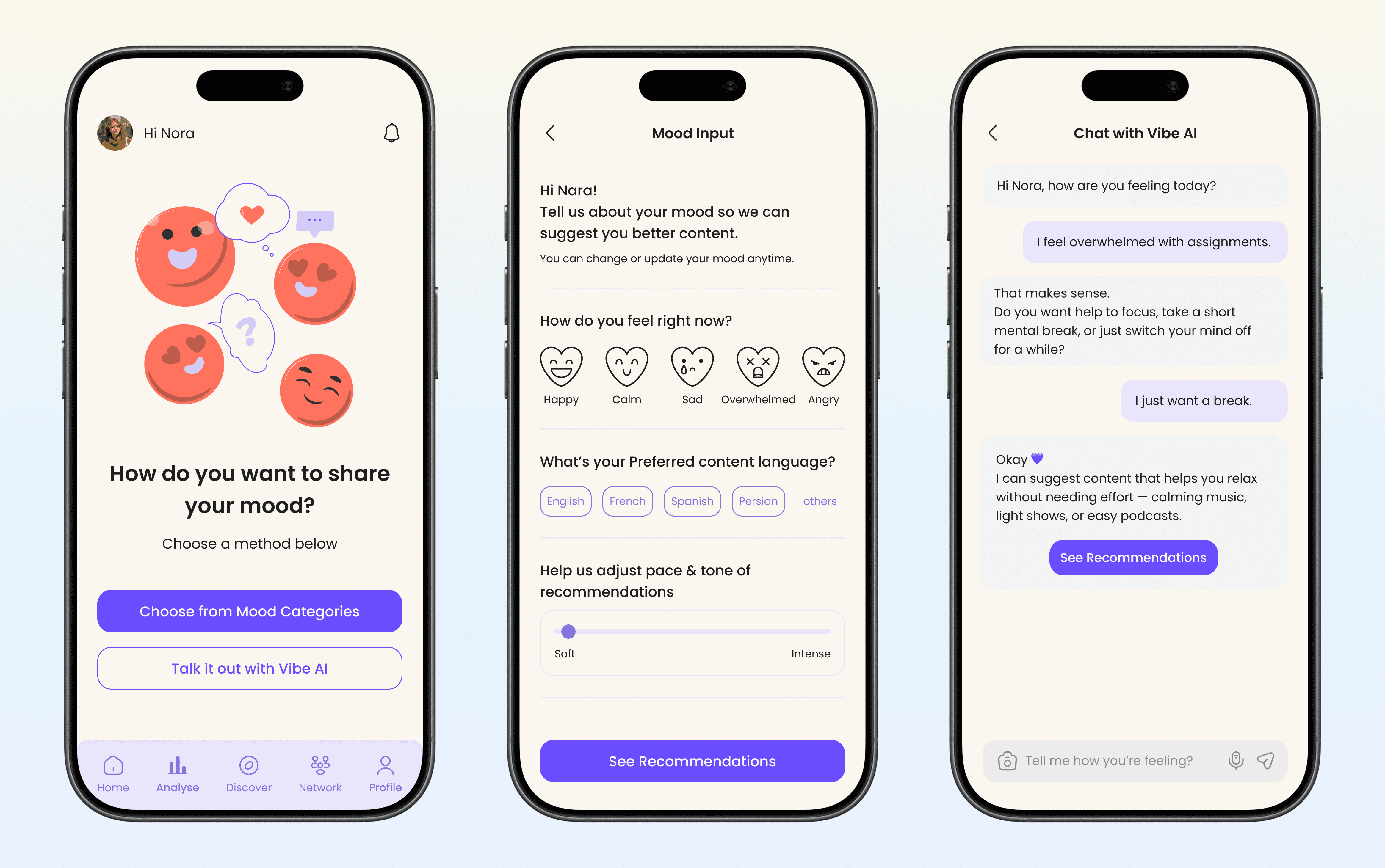
FEATURE (01) — Mood Entry
🌱 Choose from predefined mood categories
🌱 Chat with Vibe AI to describe feelings naturally
🌱 Select preferred content language
🌱 Adjust the pace and tone of recommendations
🌱 Receive personalized suggestions based on current mood
FEATURE (02) — AI Conversation
🌱 Express feelings through natural conversation
🌱 Receive empathetic follow-up prompts
🌱 Get recommendations based on current mood
🌱 Discover music, films, and podcasts with less effort
🌱 Move directly from conversation to personalized suggestions

FEATURE (04) — Mood Tracking
🌱 Discover content matched to the current mood
🌱 Explore music, films, and podcasts in one place
🌱 Refine results by genre and vibe
🌱 Open content directly in supported platforms
🌱 Reduce decision fatigue with focused recommendations
🌱 Track moods across days and weeks
🌱 View emotional patterns in a mood calendar
🌱 Reflect on recent mood changes
🌱 See weekly media preferences linked to mood
🌱 Build greater awareness of personal emotional patterns

FEATURE (03) — Mood-Based Recommendations


🌱 Discover playlists and content shared by others
🌱 Find people with similar moods and interests
🌱 Follow users and explore their recent activity
🌱 Like, comment on, and discuss shared content
🌱 Explore mood-based recommendations through the community
FEATURE (05) — Social Discovery
✨ Key Features
View Prototype
MID-FIDELITY WIREFRAMES

Design System

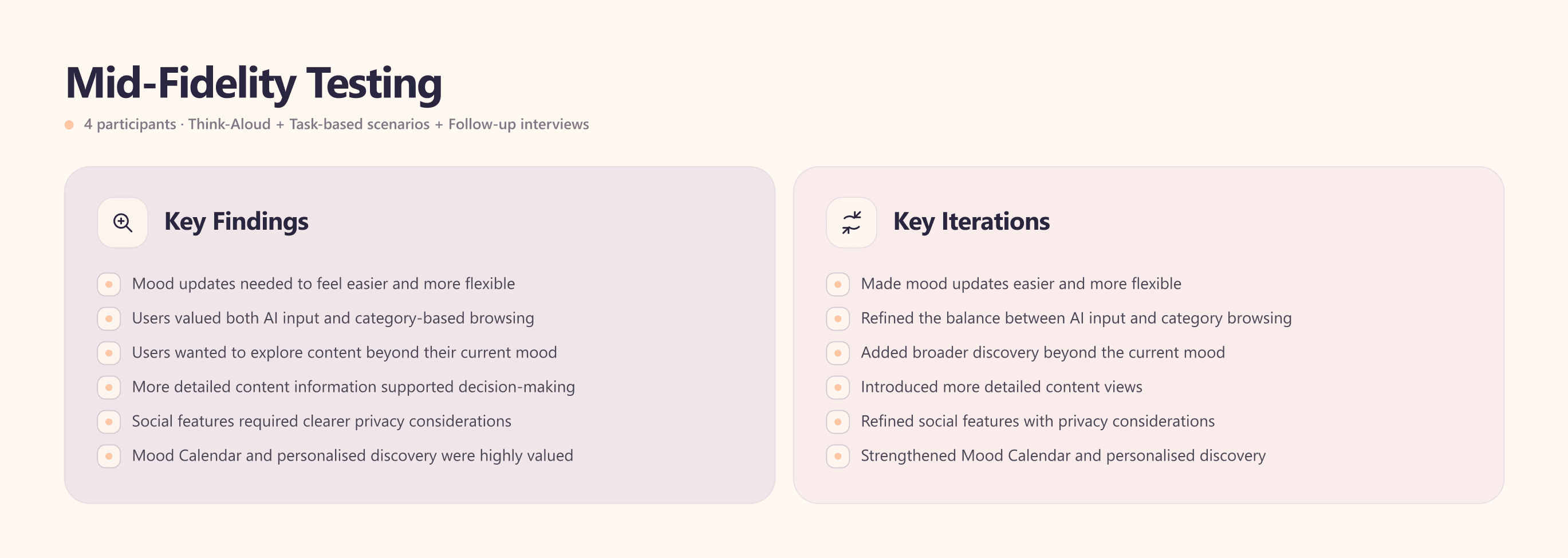
User Testing – High-Fidelity Evaluation

✨ Reflections

✨ Highlights

✨ Design Process
The ideation phase focused on translating research insights into a clear product direction for VibeMatch. I explored how users could express their mood with minimal effort and receive emotionally relevant recommendations across music, films, and podcasts, while keeping the experience simple, personal, and engaging.
LOW-FIDELITY WIREFRAMES

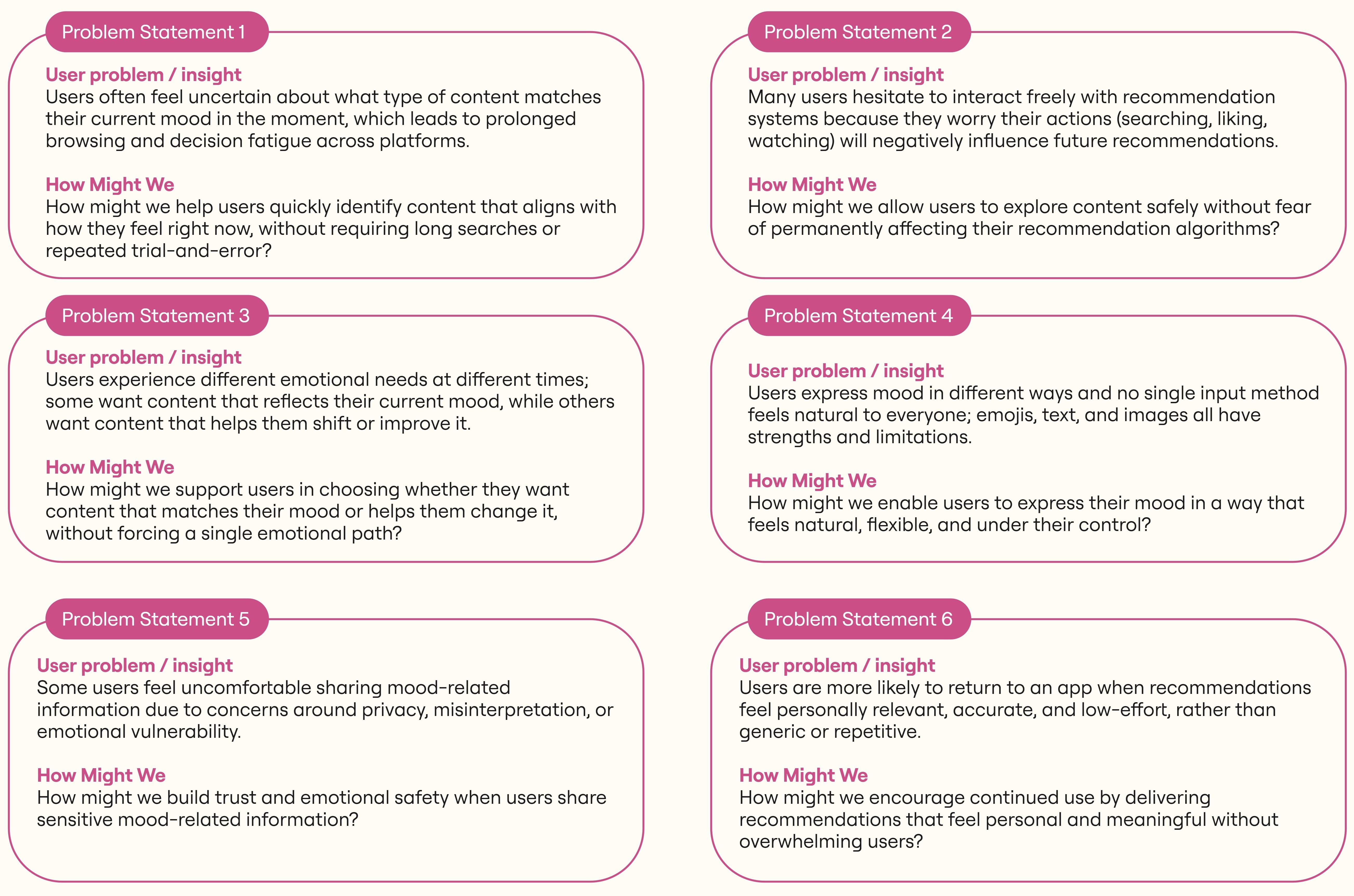
PROBLEM STATEMENT & HMW QUESTIONS
Ideation
At this stage, low-fidelity wireframes were used to quickly explore layout ideas and refine the user journey.


✨ The Solution

WHAT ARE THE END GOALS OF VIBEMATCH?
A mood-driven platform that connects emotions to music, film, and podcasts.
Vibematch
Design Brief
• Users are overwhelmed by too many content choices
• Existing systems rely on past behaviour, not real-time emotions
• Users struggle to find content that matches their current mood
Timeline
May 2025 – January 2026
Role
End-to-end UX design (research → prototype → testing)
✨ Highlights
✨ The Challenge
WHAT ARE THE END GOALS OF VIBEMATCH?
✨ The Solution
✨ Research Summary
Market Insights & Competitor Analysis
I analysed leading streaming, wellbeing and conversational AI platforms to understand how mood and emotion are currently used in content discovery.
The comparison revealed an opportunity for a low-friction, cross-media experience that responds to users’ current emotional state rather than relying mainly on past behaviour or open-ended interaction.
The ideation phase focused on translating research insights into a clear product direction for VibeMatch. I explored how users could express their mood with minimal effort and receive emotionally relevant recommendations across music, films, and podcasts, while keeping the experience simple, personal, and engaging.
PROBLEM STATEMENT & HMW QUESTIONS
LOW-FIDELITY WIREFRAMES
MID-FIDELITY WIREFRAMES
✨ Key Features
View Prototype
FEATURE (01) — Mood Entry
🌱 Choose from predefined mood categories
🌱 Chat with Vibe AI to describe feelings naturally
🌱 Select preferred content language
🌱 Adjust the pace and tone of recommendations
🌱 Receive personalized suggestions based on current mood
FEATURE (02) — AI Conversation
🌱 Express feelings through natural conversation
🌱 Receive empathetic follow-up prompts
🌱 Get recommendations based on current mood
🌱 Discover music, films, and podcasts with less effort
🌱 Move directly from conversation to personalized suggestions
FEATURE (03) — Mood-Based Recommendations
🌱 Discover content matched to the current mood
🌱 Explore music, films, and podcasts in one place
🌱 Refine results by genre and vibe
🌱 Open content directly in supported platforms
🌱 Reduce decision fatigue with focused recommendations
FEATURE (04) — Mood Tracking
🌱 Track moods across days and weeks
🌱 View emotional patterns in a mood calendar
🌱 Reflect on recent mood changes
🌱 See weekly media preferences linked to mood
🌱 Build greater awareness of personal emotional patterns
FEATURE (05) — Social Discovery
🌱 Discover playlists and content shared by others
🌱 Find people with similar moods and interests
🌱 Follow users and explore their recent activity
🌱 Like, comment on, and discuss shared content
🌱 Explore mood-based recommendations through the community
User Testing – High-Fidelity Evaluation
✨ Reflections
THE PROBLEM
Systems rely on past behaviour, not real-time emotions
Users spend too long browsing due to mood mismatch
Mood is not used as an explicit input
WHAT ARE THE USER NEEDS?
Users want a simple and emotionally intelligent way to discover content that aligns with how they feel in the moment.
They need a low-effort method to express their current mood without complex interaction
They want recommendations that feel personally relevant rather than repetitive or history-driven
They seek relief from decision fatigue caused by excessive browsing
They value emotional alignment between their mood and the content suggested
They expect transparency and control over how their emotional input is used
UNDERSTANDING THE USER
To understand how users discover entertainment content, I conducted both secondary research and primary user research.
Conducted
• 8 user interviews
• 27 survey responses
Key Insights
• Users often consume media as a tool for emotional regulation
• Decision fatigue occurs when browsing large content libraries
• Behaviour-based recommendations do not always reflect current emotional states
• Some users experience algorithm anxiety and avoid interacting freely
• Users prefer lightweight, intuitive interaction when expressing mood
✨ Design Process
Design System
Ideation
LOW-FIDELITY WIREFRAMES